Wednesday, September 26, 2012

Wind Generation is the Future Renewable Type of Energy

The future of power generation is going to be greatly influenced by the Wind.Wind is the Types of Renewable Energy that uses a wind turbine to generate the electricity. By the end of 2009 wind generation accounted for the generation of 159.2 gigawatts, which is about 2% of the worlds electricity required. Going forward wind generation has the technical potential to produce 40 times it current electricity generation.


There is a wide range of wind turbines available for many suppliers and they fall into two categories just like most other things around the world.  There is a range of domestic wind generators ranging from 100 watts up to 1 Kilowatt and a much wider range of commercial units that range from 600 Kilowatts to 5 Megawatts however wind turbines with the rated output of 1.5 to 3 Megawatts are most commonly used in the commercial wind farms around the world.


Regardless of the rated output wind turbines use exactly the same method to generate an electricity supply. Basically they use they do exactly opposite to an electric motor. An electric motor uses a supply of electricity to energize a coil of wire (the armature) that is contained in a magnetic field this causes the armature to turn therefore supplies a source of mechanical energy. Now a wind turbine on the other hand takes it energy source from the wind and using the blades to mechanically turn the armature within the magnetic field. This movement within the magnetic field induces an electrical current in the windings, which can be used to feed into the main power grid or into a battery bank in the case of a stand-alone system.


The rate of electricity generated is proportional to the speed at which the turbine turns. Before installing a wind generator you need to do some research into whether or not the location that you live in is suitable. You need to have what as known as clean wind meaning that there is no interference to the flow of wind into the generator like trees mountains builds etc. It is also a good idea to install some wind monitoring equipment and study the amount of wind you can actually take advantage of. You may find that your location is not suitable for a wind generator and you may need to look at other types of renewable energy like Solar Panels.


The use of wind generators for the creation of electricity is growing across the globe by a staggering rate of 30% per year. The fact that people are using the power of the wind it is making Wind Turbines one of the forefront in the Types of Renewable Energy and as the need for more electricity and the need to reduce greenhouse gases there will be more research and development conducted to better the technology that we are already using to make wind turbines more efficient and cheaper to construct.  As they find was to make them cheaper the more people will choose to use them making it a win win situation for use and the environment.

-
About the Author:
If you would like to learn more about renewable Energy and you are a bit of a DIY kind of a person Have a read about my experiences with different Types of Renewable Energy.
Article Source

share save 171 16 Wind Generation is the Future Renewable Type of Energy

Source: http://reschelectrical.com/wind-generation-is-the-future-renewable-type-of-energy/

electrical installations electrical certification electrical inspection

How to Cut Your Electric Bill in NJ

Electric Bill

One of the major concerns in the world today is depletion of energy. As concerned citizens all of us must make a concerted effort to be conscious citizens and save on our electric bill in NJ. Electricity has become integral to life but imagine having to live without power.

Conservation of electricity benefits you personally as you will cut your electric bill. Consider:

1.    Doing an energy audit. This will tell you how and when you use energy and where the wastage lies. You will be able to make an “energy savings plan” by pinpointing exactly how you can cut back on energy consumption. Some ideas may be as simple as don’t leave the coffee machine on at all times.

2.    Think about resetting the thermostat ten degrees lower during the night. If you can do this for say approximately eight hours a day you will save 10% on electricity without sacrificing comfort. Insulate the home in winter by drawing shut the drapes.

3.    Check all insulation in the house. If you increase attic insulation to around 12 inches the electricity consumption will reduce by 20 percent.

4.    Plant more trees around the house these will cool the house in summer and insulate the house in winter. Studies show that a green cover benefits in many ways.

5.    Have all electricity wires and outlets checked for leakage. Check all fuses and appliances.

6.    Fluorescent light bulbs are energy efficient. They use 75% less energy than ordinary light bulbs, this will definitely help cut your electric bill.  These have a longer life and contribute to great savings.

7.    Use energy efficient appliances. These use less energy and believe it or not a high efficiency refrigerator uses less electricity than a light bulb.

8.    When you are away even for a few hours or days you should turn off and unplug   all electrical appliances and turn settings on the thermostat, water heater, and refrigerator to the lowest setting.

9.    Ensure that you use a water-saving shower head. Water heating costs for a family can be lowered by at least US$ 250 a year.

10.    Weatherize your home. This helps reduce heating bills by 20% and cooling by at least 10 percent. Even when building a home or decorating it use weather friendly materials—those that are not good conductors of heat and cold. Install windows and glass panes in the roof in such away that you use sunlight to light up the rooms during day light hours. Make an effort to switch off lights and fans when leaving a room. Ensure that the filters in air conditioners and heaters are always cleaned and free of clog and dust.

If you live an energy efficient lifestyle you will see the numbers on the energy bill actually reducing. The power to cut energy costs is well within your control. It is as simple as only washing full loads and that to in cold water. Use the hot wash option only for very dirty clothes.  Cook food only just before you are ready to eat that way you can save reheating costs as well as refrigerating costs of storing the food. Turn the thermostat of the refrigerator to minimum in cold or cool weather. Switch off freezers if they are not in use. Small contributions can all add up to significant amounts of power saved. And, power saved means money in the bank.

Electric Bill

share save 171 16 How to Cut Your Electric Bill in NJ

Source: http://reschelectrical.com/how-to-cut-your-electric-bill-in-nj/

electrical tools electric work electrical services electrical parts home contractors

How Long To Grow Tomatoes – Juicy Delicious Tomatoes

Ketchup is just one by product that you can get from tomatoes. And the fresher it gets better it is. To give you freshly picked tomatoes, you might want to learn how to start growing them. But instead of just learning how long to grow tomatoes, it is ideal to learn the essentials on how to care for them as well. There are only a few rules to follow so better start learning them for you to reap the rewards of fresh harvest in no time.

Click Here For Juicy Delicious Tomatoes Instant Access Now!

As have said earlier, there are only a few basic steps in trying to grow your own tomatoes. And depending on how well you take each aspect in consideration, it will pretty much determine how long to grow tomatoes. You can always ask your neighbors if you seem to lack such information or you can find yourself a guide that you can now find online these days.

One of the things you might want to have in order to produce the best tomatoes is the proper lighting. As a matter of fact, the more you expose your crops to sunlight, the better they are going to get. However, make sure not to place them in a place where wind is abundant.

Another thing to consider is the soil you are planning to plant your tomatoes in. The best thing to do is to sterilize your soil from time to time. It is recommended to do so twice every season. What is important is that your soil is free from various infections or diseases that could affect your plants.

It is also important to keep your soil moist at most times. These are just some of the things to consider. Why learn how long to grow tomatoes if you could only learn the best ways to care for them instead. Doing so will surely get you there – an unlimited supply of fresh tomatoes.

Click Here For Juicy Delicious Tomatoes Instant Access Now!

-
About the Author:
This author writes about Tomato Planting Tips at Juicy Delicious Tomatoes
Article Source

share save 171 16 How Long To Grow Tomatoes   Juicy Delicious Tomatoes

Source: http://reschelectrical.com/how-long-to-grow-tomatoes-juicy-delicious-tomatoes/

electrician company electrician tools electrician commercial

Tuesday, September 25, 2012

Windpower Consequences (Part I: Introduction and Summary)

This post introduces a five-part series that summarizes some of the most important information about the present and future of industrial wind power in light of the growing backlash against the industry’s taxpayer dependence. Readers are invited to add anything that I have missed.

Continuing government support for windpower must confront two questions. First, why do so many people think that we have to revolutionize our energy systems right now to avoid the consequences of running out of fossil fuels (or suffering very high costs), climate change, or other possible challenges that we might face? Note the emphasis on “right now,” meaning starting now with substantial changes in energy system directions, especially electricity systems, involving massive implementation of grid-connected, industrial-scale wind and solar generation plants.

Second, what is required for wind-subsidy proponents to agree that forced energy transformation is not feasible? A notable and growing number of people have tried with some success to close the gap between reality and romance, but progress has been slow because of the size, power, and persistence of the pro-wind movement. Without enough knowledge on the subject, the general public and media naturally rely on this movement in government, some of the scientific community, and many environmental groups.

Later posts will show why industrial wind fails the feasibility test to constructively change our electricity systems. The implications for government/taxpayer policies are obvious.

Response to the First Question

Drastic measures appear to make sense if most people believe a “silver bullet” solution (to some perceived threat requiring immediate action) is truly at hand. Setting aside a lengthy and contentious discussion of threats, is a “silver bullet” solution available to such a threat anyway?

This is apparently so, or so the pro-wind movement would have us believe. It is a revolutionary change to massive amounts of “new” renewable energy sources, wind and solar, especially wind, with extension to “clean energy” electrification of the transportation sector. I use quotes around the word new because they are new only in the sense that some, indeed many, are re-branding these old energy sources as viable and relevant in our current, complex, and high-energy-need times.

Proponents of some of these “new” renewable energy sources will say that their position is not one of providing a “silver bullet,” but is that we must have a range of energy sources available to us. This is a poor argument as the same could apply to justifying the presence of unproductive, unreliable employees in a company on the basis that every little bit helps. A lot of the “silver bullet” aspects get lost in soft, persuasive language, which does not require us to think much. The “silver bullet” label is valid in part because if we do what the “experts” and those in authority are telling us, we believe, albeit somewhat unconsciously, we can comfortably continue our lives as before.

Regardless of any such claims, what they propose is a revolution that must start immediately, with fast and substantial change in our electricity systems to new energy sources. But this revolution is long on proclamations and short on substance, so it is bound to fail in time. Unfortunately if further pursued, its failure will have severe adverse consequences on all aspects of modern life, for example in government, law and order, food and water supply, education, health and medical care, all forms of emergency services, commerce, industry, economic well-being (add to this list whatever is important to you). This is due to the risks this revolution brings to the viability of our electricity and financial systems. Future generations will not thank us for such policies. They will curse us for our folly.

One of the conclusions I have come to is that if major change is needed earlier, it is in society. As it now appears, the societies of developed, developing and undeveloped countries must make substantial changes before better energy solutions become feasible. We could have a pleasant surprise putting less pressure on the need for societal change. More likely is an unpleasant surprise, for example in the form of economic failure, which would have the effect of addressing many perceived threats, but in a highly undesirable way.

Either way, in the meantime we need access to economic, reliable energy – as and when required – on a continuous basis, starting now and for the foreseeable future, that is, the next 20-40 years or so. This is the sort of minimum time frame for the types of changes that must start to occur, whether societal or energy supply and is the optimal approach to best prepare us to meet threats, forecast or not.

To those who would argue that time is not on our side, I would respond that the only more timely approach that will deal satisfactorily with any currently feared threats is aggressive conservation, which is a societal change matter.

This led me to some of the keys in understanding our current confusion. First, we do not adequately take time frames into account when thinking about energy sources and systems change. Second, we do not properly appreciate what we have, and the need to maintain and improve it as the first important step, which should occupy us for the next 40 years or so. Third, we do not comprehend the monumental task of change in our energy infrastructures. Electricity is so completely imbedded in everything that we do and is so vital to us that it will take well architected, engineered, and implemented programs for change. Significant changes will be a long time coming, and we should be thinking of the second half of this century for this.

So once more, let me outline in more detail why such currently proposed energy policies involving revolutionary change are wrong.

Response to the Second Question

The folly of current conventional wisdom on energy policy will be dealt with in summary form below under the following headings:

  • Energy return on energy invested
  • Costs
  • Subsidies
  • Emissions reduction
  • Other considerations, which include European energy policy flaws

Details will be provided in future posts in this series.

Energy Return on Energy Invested

This is commonly referred to as EROEI (sometimes simply EROI). I have not seen much emphasis on this way of looking at the viability of energy sources, but it seems to becoming more of a focus in energy analyses, even in the personal investment world.[1]

Tom Murphy of UCSD in his article “The Energy Trap: Do the Math” demonstrates the problems with the necessity of investing energy to access energy sources. His analysis looks at the impact of accounting for all the energy invested on a realistic front-loaded basis, but assumes the associated conversion means (generation plants) operate at full capacity over their expected lifetimes. The results after conversions to electrical energy are treated in general terms only, and I take this analysis further. My approach also provides the opportunity to expose more aspects of the associated energy sources, even if the upfront investment is amortized over the life of the energy source.

I also have had some correspondence with Thomas Homer-Dixon, who is (amongst other positions) the Director of the Waterloo Institute for Complexity and Innovation. One of his papers, “Complexity Science and Public Policy” discusses the importance of complexity in modern societies and its associated high energy needs. EROEI considerations are important, as Homer-Dixon points out in his paper:

“Taking the average energy return on investment of all energy sources in our economy, as we slide down that slope from 100:1 to 17:1 to 4:1 to 1:1, we’re inexorably using a larger and larger fraction of the wealth and capital in our economy simply to produce energy, and we have less left over for everything else we need to do – like solving our increasingly difficult problems.”

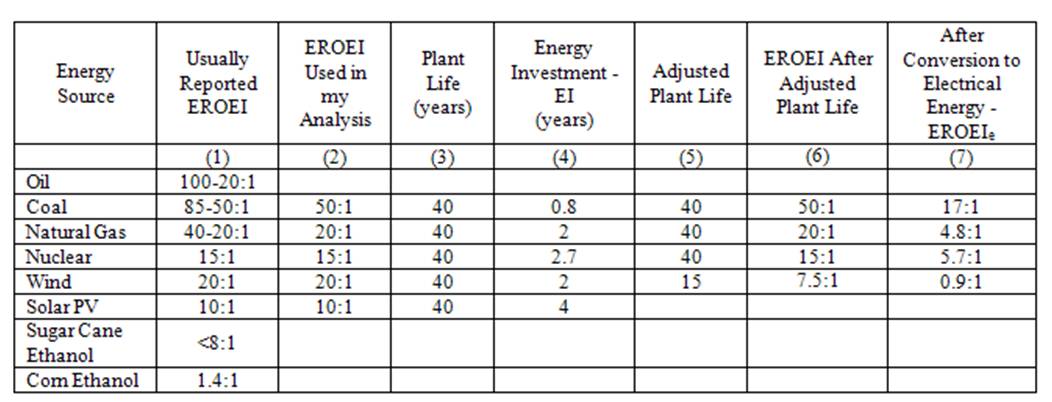
The EROEI for a number of energy sources is shown in Table I-1. Some obviously do not apply extensively to electricity systems but are included for general interest. I have purposely omitted hydro-electric energy, which has an EROEI of 100:1 because, like other renewable energy sources, it does not scale well, due to the size of reservoirs needed. Proponents of pumped hydro storage in support of substantial wind implementation take note.

Columns 1-4 are from the Murphy’s paper referenced above, and 5-7 are my further analysis.

Table I-1 – EROEI Before and After Conversion to Electrical Energy
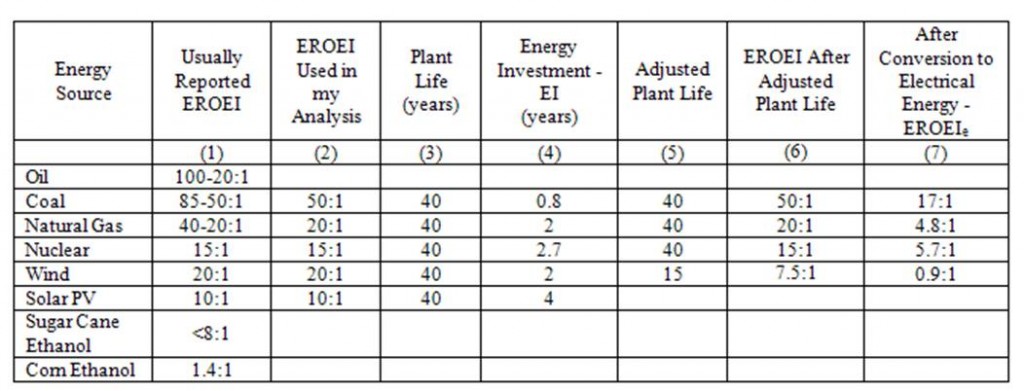
The EROEI ranges shown in column 1 represent declining trends, and I use the more current ones (column 2) in my subsequent analysis. The energy investment (EI) includes energy components for plant implementations and fuel provision.

Even given a positive EROEI before conversion to electrical energy, wind produces a negative post-conversion result. This alone should disqualify it from consideration for commercialization. Industrial-scale solar is not considered further in this analysis because of its already low initial EROEI.

Again from Homer-Dixon’s paper:

“A modern society can’t sustain its complexity with low-quality energy; it needs copious quantities of high-quality energy.”

Because of their persistent erratic behavior, wind plants do not provide high-quality energy and rather extreme measures have to be taken to integrate them into our electricity systems, which already have a high degree of complexity, and this is reason enough to be careful. These measures are often disregarded when assessing costs, emissions, reliability and impacts on users, residential, commercial and industrial.

EROEI an important measure of the viability of energy sources, but many other considerations are equally so. First, a look at costs.

Implementation and Levelized Costs

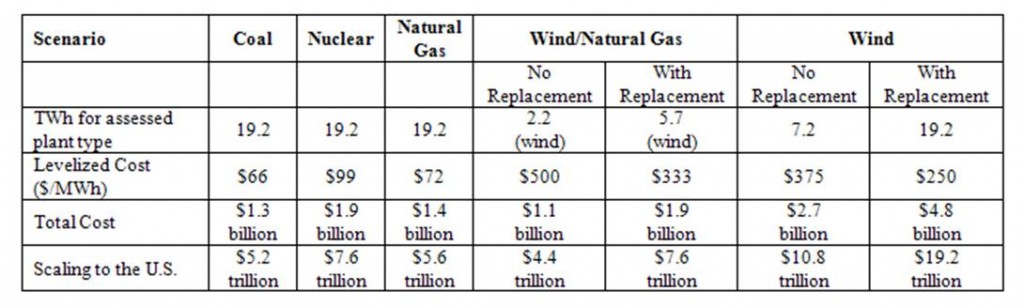
This and the next two sections are based on projections for five scenarios over a 13-year period, say from 2012 to 2025. In each scenario a generation technology is selected to fill the gap between plant retirement and growth in demand based on electricity production of 1 TWh in 2012. This allows for easy scaling, for example to the U.S., which consumes about 4,000 TWh today.

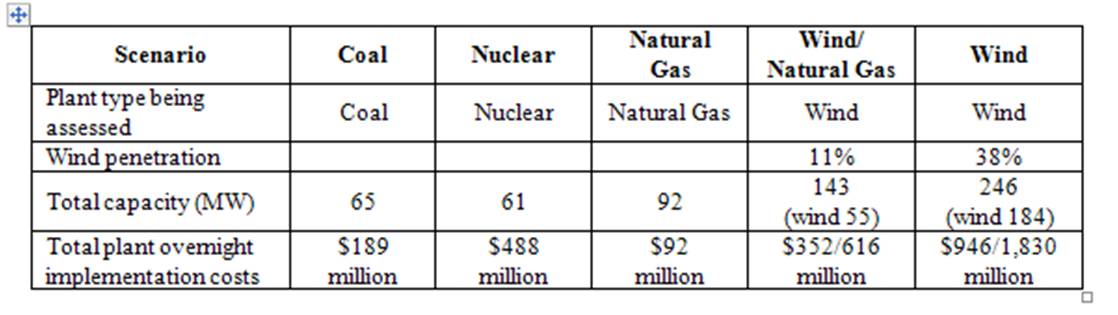
Table I-2 provides a summary of the findings. The wind scenarios demonstrate two levels of wind penetration as shown. In the first, Wind/Natural Gas, both plant types are used to fill the gap and in the second, wind alone is assumed. The wind alone scenario is not feasible for many reasons. For example, extremely high levels of curtailment would be necessary, but it is instructive, and as some might project high wind penetrations, it is included. Both wind scenarios require gas plant balancing to provide the steady, reliable electricity which we require.

Table I-2 – Total Plant Overnight Implementation Cost for the Scenarios
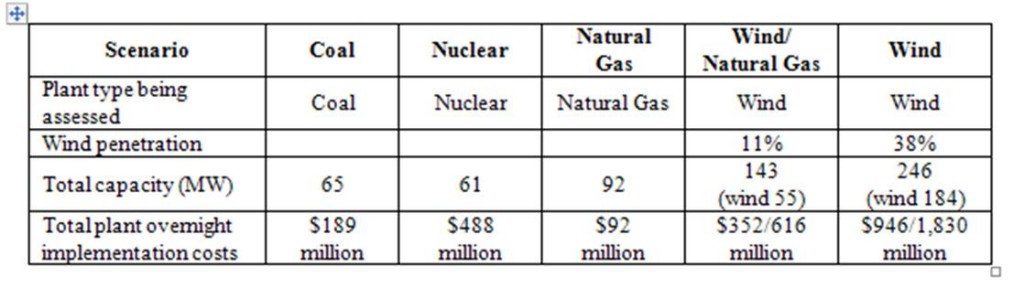
Implementation costs for wind include the costs of gas balancing plants and grid changes unique to wind. The two values for wind are for the initial implementations only (15 year wind plant life) and for the wind plants being replaced twice in a 40 year period, respectively.

Total Costs

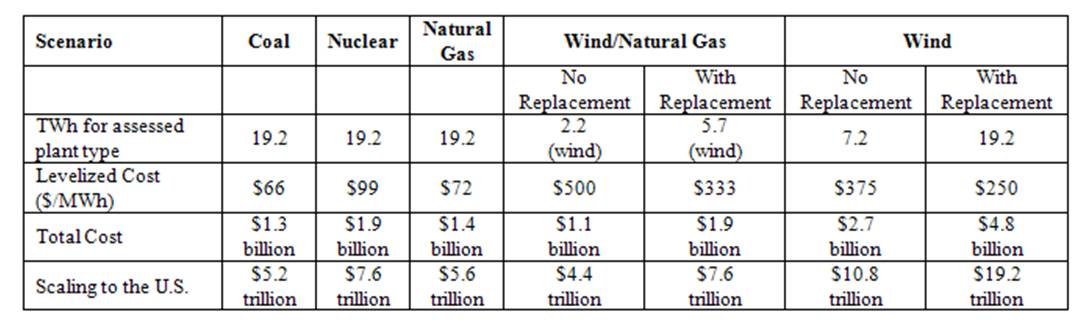
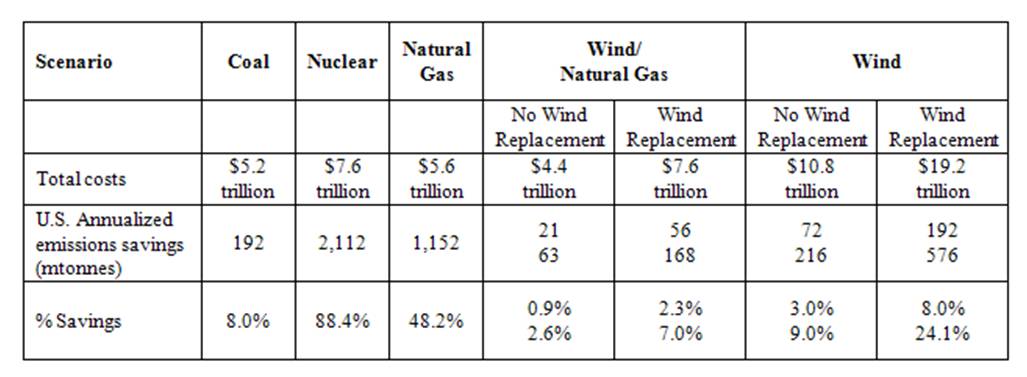
The total costs are based on the full levelized costs, which include financing and operations and maintenance costs, and in the wind scenarios, wind balancing gas plants and grid changes unique to wind. The analysis takes the year 12 new plant configuration and projects it over the 40 year life for most of the plant types involved, involving 19.2 TWh (which is 0.48 TWh x 40). As indicated above there are two possibilities for the wind scenarios: (1) Wind plants are not replaced at the end of their 15 year lives but some stranded costs persist for the wind balancing gas plants and unique-to-wind grid additions, as these are amortized over 40 years, or (2) Wind plants are replaced, which is unlikely but this provides a basis for some useful comparisons. Table I-3 shows the results.

Also shown is the effect of scaling to the U.S. electricity system.

Table I-3 – Total Costs for All Scenarios
Subsidies

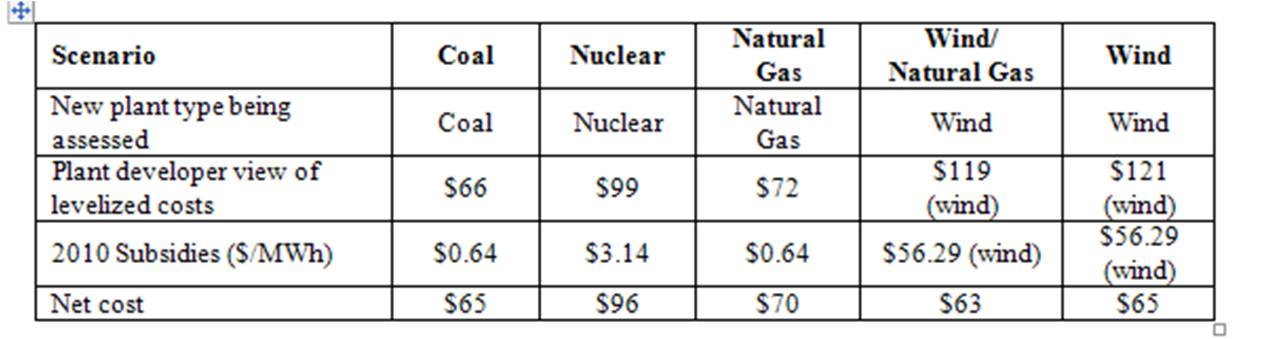
A natural progression from costs is the level of subsidies on the same basis, that is, per MWh. Table I-4 provides a summary of the findings. Note the costs shown here are as seen by the plant developer/owner, not society at large as shown in Table I-3.

Table I-4 – Levelized Costs (Plant Developer/Owner View) and Subsidies ($/MWh)
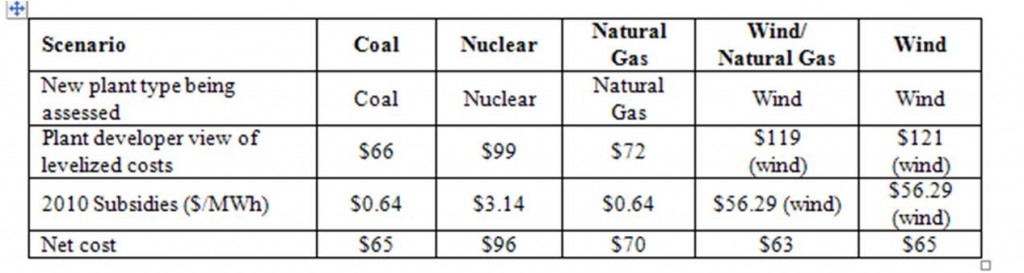
This superficial view of wind subsidies appears to put wind at the same “cost” as the coal and natural gas plant types, and notably below nuclear. Comparisons cannot be made without the full wind costs taken into account. Remember this when claims are made about wind being competitive with other generation plant types.

Emissions

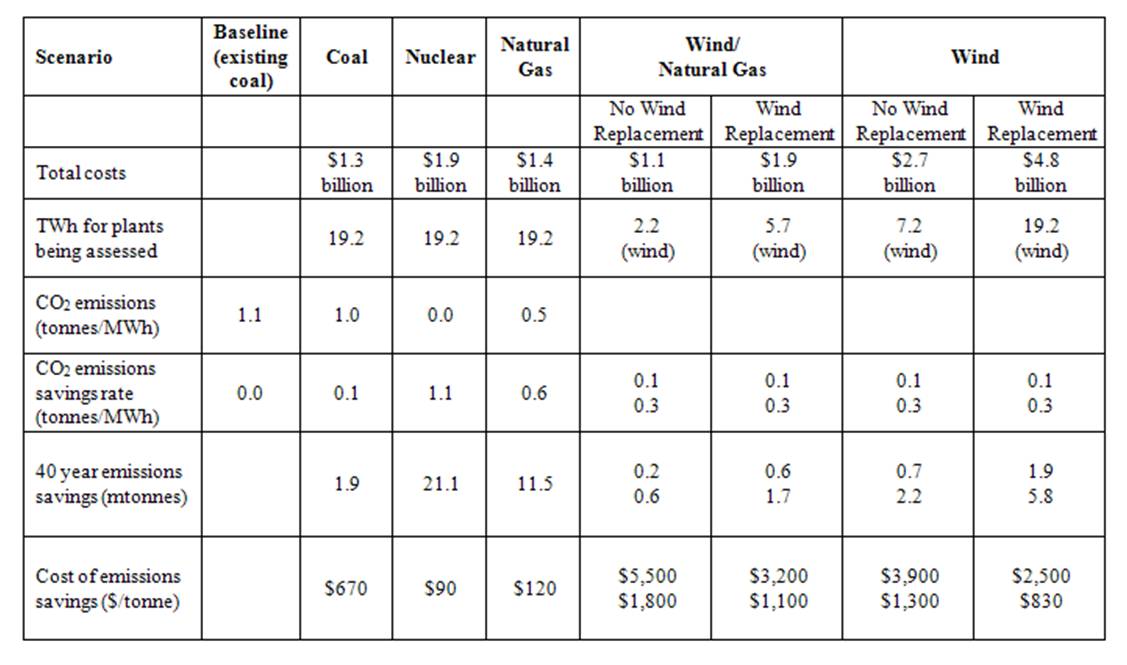
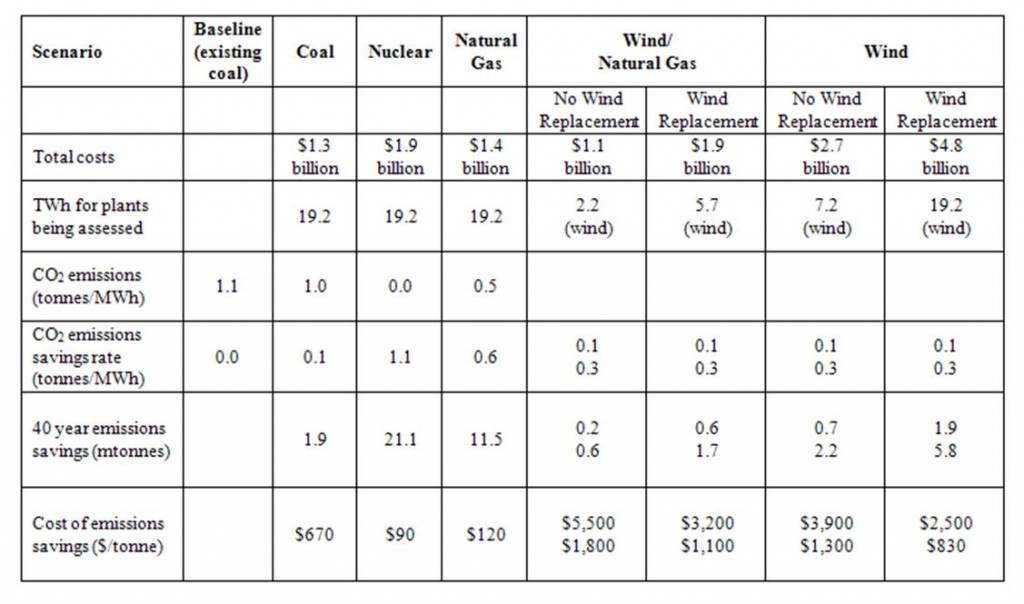
Emissions savings and costs are projected over the expected plant life, and Table I-5 shows the results. In this table wind CO2 emissions savings per MWh are shown at two levels: (1) at 0.10 tonnes/MWh to avoid dividing by 0, which produces a result of infinity, and (2) a generous 0.30 tonnes/MWh, which illustrates the relative poor and expensive contribution of wind even in these circumstances.

Table I-5 – CO2 Emissions Savings and Related Costs Compared to Existing Coal Plants
The implications for the U.S. are shown in Table I-6, based on the 2010 CO2 emissions from electricity generation of 2,389 million tonnes are shown in Table I-6.

Table I-6 – Scaling Emissions Results to the U.S.
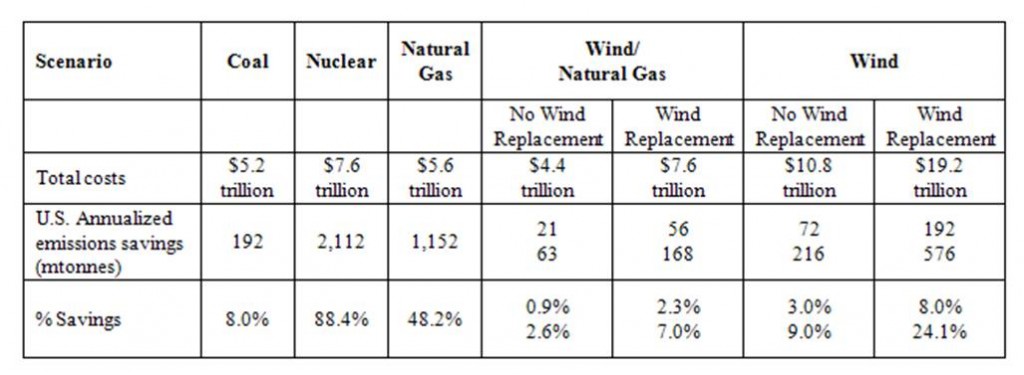
The most likely outcome of pursuing wind as a CO2 emissions reduction strategy would be the “Wind/Natural Gas” scenario with the “No Replacement” option. In this time frame it should be amply demonstrated that wind is not a feasible policy. However there is the risk of electricity capacity shortfalls as a result and precious time will have been lost.

For complete comparisons between the scenarios, the “Wind/Natural Gas” with “Replacement” option is more instructive as all plants being assessed are producing over the period of 40 years. The wind savings are most likely in the range of few percent over the life of the wind plants at a cost of $7.6 trillion, compared to nuclear with 88% emissions savings for the same cost and natural gas at 48% savings for $5.6 trillion.

The total costs are important considerations, because these investments will be made involving significant debt.

Other Considerations

There are many other negative consequences with industrial-scale wind plants, including:

  • No creation of jobs or a sustainable industrial policy
  • Harm to human health
  • Harm to other local flora and fauna
  • Reduction of property values for nearby home-owners
  • Contribution to widening of the gap between the wealthy and the rest of society
  • No decrease in use of fossil fuels
  • Do not provide energy independence/security
  • Significant threat to financial and economic systems
  • Creation of divisiveness within communities and families

European Energy Policy Flaws

European energy policy is not to be emulated for many reasons, including the notion that bureaucrats can successfully predict winners decades into the future, and the lack of understanding of the nature and size of the investments required for questionable energy sources. For an analysis of its many flaws see my article in the European Energy News, which was originally published at MasterResource as well as other analyses here.

In summary, there is no good earthly reason to pursue policies involving implementation of wind plants, and like renewable energy sources, for electricity systems. The consequences of doing so include putting our electricity, economic and financial systems, and ultimately the fabric of our society, at considerable risk.

—————————————————

Future posts:

  • Part II – Analysis Approach and Implementation Costs
  • Part III – Total Costs
  • Part IV – Subsidies and Emissions
  • Part V – Other Considerations and Conclusions

[1] I subscribe to an energy investment newsletter which recently had an article focusing on EROEI considerations for guiding energy investments. In the interests of full disclosure, I have not owned (to the best of my recollection and possibly through mutual funds at some distant time), do not now own, or plan to own, investment instruments in the energy sector. My only investments, outside of Canadian government guaranteed cash equivalent securities, is a small holding in gold stocks. I subscribe to this newsletter as another “window” on energy considerations. I have not received one cent for these posts from anyone, and I am not beholden to anyone who might benefit from them, except to the society in which I live, which I want to protect for the benefit of my grandchildren and their descendents.

Source: http://www.masterresource.org/2012/09/wind-consequences-i/

electrical contractor in what is an electrical contractor electrical service service electrical electrical jobs

Power Quality

Poor power quality can show up in many ways, flickering or dimming lighting fixtures, computer crashes or constant air conditioning equipment failures. Sometimes determining the cause of such problems can be very complex, especially when the problems seem very intermittent. ATS Electric Inc., employs the latest power analyzing equipment that can monitor your system for [...]

Source: http://blog.atselectricinc.com/2012/04/power-quality-8/

electrician job electricians jobs electrician work

Are Your Outlets Crooked?

How many times have you seen crooked outlets in your home? I know they drive me crazy! It could be that they were installed that way. Then again, it could be that the outlets were not securely fastened to the junction box. Then there's the brute force method, where someone pulls an extension cord out the the outlets from six feet away. This muscle move can twist the outlet, if not damage it.

To me, a crooked outlet or switch is like having a finely painted picture hanging crooked in your home. It only takes a few minutes to fix the problems and with these quick tips, you'll straighten them in no time.

Read More...

...

Read Full Post

Source: http://electrical.about.com/b/2012/09/17/are-your-outlets-crooked.htm

electrician electrical contractor journeyman electrician industrial electrical electrician training master electrician

Power Quality

Poor power quality can show up in many ways, flickering or dimming lighting fixtures, computer crashes or constant air conditioning equipment failures. Sometimes determining the cause of such problems can be very complex, especially when the problems seem very intermittent. ATS Electric Inc., employs the latest power analyzing equipment that can monitor your system for [...]

Source: http://blog.atselectricinc.com/2012/04/power-quality-8/

electrician training master electrician electrical business

MAP Leadership Award

Management Action Programs, Inc. (MAP) would like to acknowledge your company’s commitment to excellence in everything you do. Your focus on outstanding customer service, quality and results has enabled ATS Electric to develop an impeccable reputation in the marketplace. A large part of your success is due to your commitment to your employee success. You [...]

Source: http://blog.atselectricinc.com/2012/04/map-leadership-award-10/

electrical construction electrical works electrical repairs electrical installations electrical certification

10 Tips for Glendora Electrical Work and Your Safety

When you’re considering electrical work you should put safety first. This article gives a few pointers regarding electricity and safety for you, your family and your home.

  1. Never take risks where electricity is concerned. Electricity can cause serious burns, health problems and kill.
  2. If you’re not qualified to do electrical works then get a registered Glendora electrician to give you a quote on the work to be done. Don’t be tempted to have a go at it yourself. It is a good idea to ask around your neighbors, friends and family who they could recommend as being good and reliable. Get several quotes and choose one according to both their ability and your price range.
  3. When you get quotes, ask for references and check them out. You should also ask to see their registration certificates to verify they are qualified and registered.
  4. Have a good look at all the work you may need doing. Check all your plugs and sockets for loose or exposed wires as well as cracked or damaged sockets.
  5. Light fittings are a common source of problems due to the heat generated by the amount of current flowing through them. Check that they are not cracked or brittle.
  6. If appliances are damaged or have electrical cables exposed you should have them tested by an Glendora electrician to make sure they are safe to use. If they’re not safe then you need to determine whether it’s more economical to repair or replace it.
  7. When all your repair work has been done, it is recommended that you cover your sockets with plastic socket covers that are not easily removed by children. This is to prevent children from pushing objects into the sockets and coming to harm.
  8. It is also worth doing a first aid course so that you are able to respond quickly in the event of an electrical accident. Many power suppliers run courses or will be able to advise you where one is available in your area.
  9. Invest in a portable fire extinguisher. Because water is a conductor of electricity you will need to get a chemical extinguisher. You need to have some sort of reminder to check the charge and that it functions correctly on an annual basis.
  10. Teach small children the dangers of electricity and how to be safe. You can use books or DVD’s as an aid to the training which are available on the internet or bookstores.

Article Source: http://ezinearticles.com/?expert=Guillermo_J_Ortiz


Source: http://www.accurateelectricalservices.com/CA-Electrician/electrical-contractor/10-tips-glendora-electrical-work-safety

licensed electrician electrical supply company electrical service contractor

Hurricane Readiness: Dealing With A Power Outage

In the midst of hurricane season, preparing for the possibility of an electrical outage is definitely something to think about. Sometimes, during an outage from a storm, it may take days to get power from your electric company. Before the lights go out, create a disaster supply kit to ease the inconvenience. You’ll need:

  • Water: At least one gallon of bottle drinking water per day, per person. Gather enough to last for seven days.
  • Food: Focus on gathering non-perishable, canned foods, juices and snacks. Again, gather enough to last for seven days. Keep in mind, a non-electric can opener, cooking tools and fuel, plastic utensils, paper plates and bowls become necessities during a power outage.
  • Hygiene: It’s difficult to stay clean without electric or running water. Gather toiletries such as toothbrushes, toothpaste, dental floss, mouthwash, soap and shampoo. You may want to have some extra water on hard, apart from drinking water.
  • Lighting: Make sure you have enough flashlights, candles, matches and extra batteries on hand to illuminate your surroundings at night. Include a couple of high-powered flashlights in your kit, along with candles to save batteries. Matches and/or several working lighters are a good idea, as well.
  • Radio: Buy an battery-operated radio to keep in tune with what’s going on during and after the storm.
  • Cash: When the power’s out, ATMs won’t work. Consider having a couple hundred dollars handy in case of an emergency.

Source: http://powergenerationinc.com/hurricane-readiness-dealing-with-a-power-outage/

electrican electrical contractors company certified electrician construction electrician able electric

Solar Manifesto

Renewable energy and energy saving up-grades – Can America afford not to go Green? America’s increasing dependence on foreign oil and the subsequent instability in many of the oil producing regions of the world has caused a great debate in this country in regards to moving the U.S. into the next generation of energy production [...]

Source: http://www.enlighten-electric.com/2012/03/solar-manifesto/

electrical tools electric work electrical services

Monday, September 24, 2012

Tax Credits For Sales of EVs

The Congressional Budget Office issued a report on this subject.

Here’s the CBO blog on it, which includes:

The direct effect of the credits is to subsidize purchases of electric vehicles—including purchases that would have been made even without the credits. Those people who purchase electric vehicles because of the tax credit use less gasoline and produce fewer emissions of greenhouse gases than would otherwise be the case. The cost to the government of those direct reductions is somewhat higher than the comparable costs of other policies aimed at the transportation sector.

Here’s the press release page (from which you can download, free, the PDF of the full report). It includes:

Assuming that everything else is equal, the larger an electric vehicle’s battery capacity, the greater its cost disadvantage relative to conventional vehicles—and thus the larger the tax credit needed to make it cost-competitive.

Source: http://electricalcontractor.com/?p=6208

electrical work electrical job electrical tools electric work electrical services

Electrician Los Angeles – Providing Landscape Lighting Ideas

Outdoor lighting can be one of the easiest improvements that you can make to the exterior of your home, and it can make a huge impact. Not only will outdoor lights improve the way your home looks at night, but it can also increase the value of your home. If you wish to sell your home in the future, you will be able to add your exterior lights to the list of amenities that your home can offer potential buyers.

Some of the most popular places to add landscape lighting are along paths or walkways, and around patios or decks. Los Angeles homeowners often place outdoor lighting at different points throughout their flower gardens, too, which creates a beautiful setting for any summer evening. By placing small outdoor lights throughout the yard, it gives the impression of twinkling stars right in your own back yard. Landscape lights can be installed in many unexpected places, such as your own vegetable garden!

Lighting Up Your Path                                                                     

The Electric Connection, a licensed, bonded and insured local electrician in Los Angeles, can be a big help when it comes to deciding what type and style of outdoor lighting to use. They can also recommend where to place your lighting, and how far apart the lights should be. It’s always best to have this type of electrical lighting done by a licensed electrician.

Lighting Your Deck or Patio

Strategically placed outdoor lighting can be just the thing to help you make better use of your deck or patio, whether you’re spending time outdoors at night simply enjoying a quiet evening at home, or if you’re hosting a big party or a neighborhood get-together.

When it comes to the types and styles of landscape lighting choices that are available, there’s no need to worry because you’ll discover that there are plenty of options to choose from. For help and suggestions, you can find us on the web at TheElectricConnection.com. You can also give us a call to chat with us about your outdoor lighting options during our regular office hours of 8:00 am to 5:00 pm, Monday through Friday. We’ll be happy to set up a free landscape lighting estimate for you whenever you’re ready to get started.


Source: http://www.theelectricconnection.com/los-angeles-electrician-blog/electrician-los-angeles-providing-landscape-lighting-ideas/

contractors electrical electrical contractors in electrical contractors

How to Cut Your Electric Bill in NJ

Electric Bill

One of the major concerns in the world today is depletion of energy. As concerned citizens all of us must make a concerted effort to be conscious citizens and save on our electric bill in NJ. Electricity has become integral to life but imagine having to live without power.

Conservation of electricity benefits you personally as you will cut your electric bill. Consider:

1.    Doing an energy audit. This will tell you how and when you use energy and where the wastage lies. You will be able to make an “energy savings plan” by pinpointing exactly how you can cut back on energy consumption. Some ideas may be as simple as don’t leave the coffee machine on at all times.

2.    Think about resetting the thermostat ten degrees lower during the night. If you can do this for say approximately eight hours a day you will save 10% on electricity without sacrificing comfort. Insulate the home in winter by drawing shut the drapes.

3.    Check all insulation in the house. If you increase attic insulation to around 12 inches the electricity consumption will reduce by 20 percent.

4.    Plant more trees around the house these will cool the house in summer and insulate the house in winter. Studies show that a green cover benefits in many ways.

5.    Have all electricity wires and outlets checked for leakage. Check all fuses and appliances.

6.    Fluorescent light bulbs are energy efficient. They use 75% less energy than ordinary light bulbs, this will definitely help cut your electric bill.  These have a longer life and contribute to great savings.

7.    Use energy efficient appliances. These use less energy and believe it or not a high efficiency refrigerator uses less electricity than a light bulb.

8.    When you are away even for a few hours or days you should turn off and unplug   all electrical appliances and turn settings on the thermostat, water heater, and refrigerator to the lowest setting.

9.    Ensure that you use a water-saving shower head. Water heating costs for a family can be lowered by at least US$ 250 a year.

10.    Weatherize your home. This helps reduce heating bills by 20% and cooling by at least 10 percent. Even when building a home or decorating it use weather friendly materials—those that are not good conductors of heat and cold. Install windows and glass panes in the roof in such away that you use sunlight to light up the rooms during day light hours. Make an effort to switch off lights and fans when leaving a room. Ensure that the filters in air conditioners and heaters are always cleaned and free of clog and dust.

If you live an energy efficient lifestyle you will see the numbers on the energy bill actually reducing. The power to cut energy costs is well within your control. It is as simple as only washing full loads and that to in cold water. Use the hot wash option only for very dirty clothes.  Cook food only just before you are ready to eat that way you can save reheating costs as well as refrigerating costs of storing the food. Turn the thermostat of the refrigerator to minimum in cold or cool weather. Switch off freezers if they are not in use. Small contributions can all add up to significant amounts of power saved. And, power saved means money in the bank.

Electric Bill

share save 171 16 How to Cut Your Electric Bill in NJ

Source: http://reschelectrical.com/how-to-cut-your-electric-bill-in-nj/

electrical construction electrical works electrical repairs electrical installations electrical certification

Advantages of Garage Organization Systems

Think about this: you are about to go to work, but suddenly, you realize you have to get through six inches of snow just to get to your car. This is because your garage is too messed up to have the slightest space just for your car.

If you think the mess in your garage is too much already, think about this: garage organization. A neat and clean garage is guaranteed to make you happy. Think of looking for something you might need in just a short while. To achieve a garage like this, you need garage organization systems. If you have a garage organization system, you could store everything you have in your garage easily. Just invest a little in organizing your garage to make things work for you. Here are just a few advantages of garage organization systems:

1.  You will not get wet from walking through the snow to get to your car because your car is simply inside your garage now.

2.  Your car gas consumption will be much lesser. The reason for this is that you will not have to run your car just to heat it up or cool it down because it has either been too cold or hot from being outside all day or night.

3.  You could also save more money because you do not have to rent an extra storage space or unit just to store all of the stuff that you could store in your garage.

So save up just a little money and start finding the perfect system for you.

-
About the Author:
Devoting some time and effort to garage organization systems can save you headaches in the long run. Get more help for your garage at http://www.yourhomeisorganized.com/GarageOrganization.htm
Article Source

share save 171 16 Advantages of Garage Organization Systems

Source: http://reschelectrical.com/advantages-of-garage-organization-systems/

electrician job electricians jobs electrician work

Why Only An Electrician Should Upgrade Your Service Panel? Electrician Broward

If you’re experiencing multiple electrical shortouts all throughout your home, they it might be time for an upgrade to your electrical service panel. In older homes, it’s not crazy for electrical wiring to be considered outdated. It’s the biggest fear for any homeowner to find out that your electrical system is too old to service [...]

Source: http://www.perfectelectricrepairs.com/2012/why-only-an-electrician-should-upgrade-your-service-panel-electrician-broward.html?utm_source=rss&utm_medium=rss&utm_campaign=why-only-an-electrician-should-upgrade-your-service-panel-electrician-broward

auto electrical repair construction electrical contractor contractors

What to do if your whole house starts flickering electrical

  1. Damage Control. Avoid using expensive equipment (like computers or flat-screens) on any circuit where you see flicker (that turns off with the same breaker as a light that flickers). Flicker is often due to a failing neutral connection, and eventual total loss of a neutral can put 2x voltage across the outlets in some wiring configurations. This can destroy electronics.
  2. Try to identify at least one circuit (lights and/or receptacles with lights plugged into them, all controlled by a single circuit breaker) that does NOT flicker, ever. Most likely, a newer kitchen or bathroom circuit, or something maybe near the breaker panel in the basement. If you cannot find any circuits unaffected by flicker, call PECO for free service that will rule out a fire-damaged or otherwise loose connection on their lines. Look outside and try to tell whether your service drop from PECO lines comes in a) from overhead lines on the street, via a tap from the PECO lines that is independent of other houses (or shared with only one neighbor), b) via a common cable running along the back of all houses on your side of the block, or c) entering your basement from underground, via a big rectangular steel box.
  3.  If your service drop is from overhead and shared down the block, the fire very likely DID affect you, and you can chat up neighbors to see if they’re having the same trouble, while you wait for PECO to confirm/deny this. If it is overhead but independent of neighbors or only shared by one neighbor, then the fire is probably irrelevant. Still, you may have a loose connection to PECO lines or there could be trouble on PECO lines that they can rule out for you, for free. Look up and down the block for signs of obvious damage to the PECO lines that you share with your neighbors. A run of 240V, single-phase utility lines behind a row of twins has come loose from its mechanical supports on one building. Resulting strain on splices may cause intermittent or arcing connections that would result in flicker for affected buildings. Corrosion and/or loose terminations at the service equipment could cause intermittent and/or arcing connections and result in flicker on alternating rows of breakers served by the loose/corroded conductor.
  4. Connect a microwave, vacuum cleaner, or space heater and see if turning it on/off contributes to flicker. Does it affect more than one circuit, or just the circuit where you plug it in?
  5. If more than one circuit breaker is affected, but NOT all circuit breakers, try to determine whether the flickering is affecting breakers on alternating rows of breakers. Because the twin (and opposite) phase conductors (aka ‘hots’) feed alternating rows down the two columns of breakers in your panel, only even rows or only odd rows affected would indicate that one, but not both, of the phase conductors somewhere between PECO and your main breaker has a loose connection at one of its terminals. It is rare for both phase conductors to go loose at the same time, so a ‘loose hot’ condition appears with this characteristic symptom of alternating rows totally out, or flickering.

What to do if your whole house starts flickering electrical Copyright Robert Monk, 2012

Source: http://www.phillylicensedelectrician.com/what-to-do-if-your-whole-house-starts-flickering-electrical/

electrical inspection electrical maintenance electrician certification

Electrician in Los Angeles Makes Electric Vehicle Charging Easier

BMW, Honda, Ford, Mitsubishi and Nissan all offer full electric vehicles; however, despite the groundbreaking technology introduced in the new crop of electric cars, sales of pure electric cars that run off of a battery alone have risen by only about 6% from the same time a year prior, according to Edmunds.com, the leading automobile information company.  An analyst from Edmunds.com believes that what he calls “range anxiety” prevents most consumers from purchasing fully electric vehicles. It is also widely believed that this slow increase is due in part to the high prices of these vehicles. Furthermore, there is very little public charging infrastructure, which can make using an electric vehicle as a primary vehicle difficult for many consumers.

The sales of hybrid vehicles, on the other hand, are going through the roof. These automobiles travel using their battery power until a traditional gas engine turns on. One of the main reasons that hybrids are doing so well is because of the plethora of options. Hybrid vehicles eliminate much of the anxiety associated with limited range due to their ability to use a gasoline engine in addition to their plug-in battery. The proposed Ford C-Max Energi, for example, can drive for approximately 20 miles on electricity alone and an additional 530 miles with its gasoline engine. This makes them not only practical for everyday use, but also for longer trips. As a result of the variety of options and advancement of the technologies in these vehicles, sales have soared 381% in the first half of this year.

Although pure electric vehicle sales are lagging behind those of hybrid sales, it is important to remember that the technologies used in these vehicles are still relatively new, and with time are likely to advance very quickly as demand and interest in these vehicles grow. Because of this projected increase in demand and technology, a licensed electrician such as The Electric Connection expects to install many electric vehicle charging ports over the next few years. It is very common for a Los Angeles electrician to install easy to use charging stations right in your own garage.

In addition to Toyota’s new plug-in version of the Prius which can be charged with the assistance of a charging port installed by an electrician in Los Angeles, Chevrolet has introduced the Volt, and Ford will be releasing the C-Max Energi hybrid, which will be coming out in late 2012.

For more information on electric vehicle charging and electric vehicle technologies, you can read more at TheElectricConnection.com

Source: http://www.theelectricconnection.com/los-angeles-electrician-blog/electrician-los-angeles-electric-vehicle-charging-easie/

electrical technician master electricians electrical construction electrical works electrical repairs

Schedule A Thermographic Electrical Inspection

Schedule A Thermographic Electrical Inspection 


Top 5 Reasons:

For any industrial business or operation, it is important to catch equipment and electrical problems before any operating failures can occur. Any problem that does go undetected can inflict extensive damage on your equipment and your business as a whole. Thermographic electrical inspections use High-Definition Thermographic (Infrared) cameras in order to determine temperature changes in electrical components. To help illustrate the importance of thermographic inspections, here are five factors to consider.

1. Catch Defective or Failing Components Early:

You can't always tell when a piece of equipment is about to fail. They don't all smoke and make noise. Instead, thermographic imaging is used to detect temperature abnormalities. This also works well with concealed equipment. By finding potential problems early, they can be fixed so that there is no down time.

2. Prevent Loss of Production Time:

An operating failure can shut your operation down for days, weeks or even longer. Keep your operation up and running and productive at all times by scheduling regular thermographic electrical inspections.

3. Save On Maintenance and Replacement Costs:

Regular thermographic inspections can help you save on maintenance costs and the costs associated with replacing failed equipment. By catching issues early on, your equipment will last longer with fewer and less-frequent replacements overall.

4. Prevent Fires and Personal Injury:

If left to get worse, loose wiring, faulty breakers and other problems can easily cause a fire. Furthermore, failed equipment can create safety hazards that have the potential to harm you or one of your employees. Don’t take chances. Predictive thermal inspections will help you protect your business and your staff from any dangerous conditions.

5. You Can Schedule During Regular Business Operations:

There is no need to shut down production simply because you have scheduled a thermographic electrical inspection. The best time to conduct a thermographic scan is when business is running as usual, as that is when most problems occur. Your inspector will work around your equipment and personnel. You might even forget the inspector is there.

The Inspection Results

When you schedule a thermographic electrical inspection, you will receive a complete report from your inspector that includes any abnormalities found, along with recommended courses of action. If there are any issues that demand your immediate attention, those will be focused on first. The report includes high-definition images and comparisons of scans over time. If there are any issues with your electrical systems or components, your inspector will find them.

By now you should be convinced that a thermographic electrical inspection is a wise decision and investment. With state-of-the-art equipment, training and certification, your inspector will attempt to catch potential problems before they are realized. If conducted regularly, you can extend the life of your equipment, save on maintenance and replacement costs and you can protect your business from down time and other disasters. By checking your electrical switch gear, panels, buss bar feeders and all other components and equipment, your thermographic inspector will help you find even the smallest of problems before they get out of hand.

We provide Thermography Cincinnati Inspections and Nationwide.

Source: http://cooper-electric.net/schedule-a-thermographic-electrical-inspection/

electrician job electricians jobs electrician work

Sunday, September 23, 2012

A Ceiling Fan Trick for Saving on the Electric Bill in the Summer

I’ve saved hundreds of dollars on electricity in the last couple of years. During the summer in Los Angeles, the biggest dollar gobbler on our household electric bill is air conditioning. My wife and I need a cool bedroom at night or we don’t sleep well — 75 ̊or lower. I learned a trick with a bedroom ceiling fan that really saves on electricity.

Ordinarily, a ceiling fan lowers the temperature a couple of degrees. When it’s 82 ̊at bedtime, that helps a little, but we still have to run the A/C. In earlier summers, we just turned on the air conditioning and set the thermostat for 75 ̊. All night long, the compressor on the roof turned on and off, and was on about half the time. It’s a 4-ton air conditioner, so every hour it costs us 50₵ (http://www.tampaelectric.com/data/files/applianceusage.pdf). If it’s on for 4 hours, that’s $2 a night or $60 a month. That’s just for nights, let alone hot summer days.

Some homes have even larger air conditioners. Depending on the size of yours, air conditioning will run you 18-67₵ per hour for electricity. That’s $22-$80 a month if it’s on four hours a night.

I got wise the last two summers. In L.A., most nights, the temperature drops below 75 ̊. If we’re not using the A/C upstairs where the bedroom is, as soon as it’s cooler outside than in, I open a few windows. I don’t run the A/C at the same time that the windows are open for obvious reasons. I don’t want to make it hard on myself, so I open only four upstairs windows that slide easily. One is a tiny window in the bedroom. I also open doors so that air can circulate from the open windows into the bedroom. Then, I turn on the ceiling fan in our bedroom, just enough to get the air moving throughout the upstairs. That draws in cooler air through from outside. I leave the windows open and the ceiling fan on low the rest of the night.

I still set the thermostat on the air conditioning to 75 ̊ and sometimes when I first go to bed, it comes on. But usually only briefly. This ensures that the bedroom is down to 75 ̊or lower all night long.

Except during bad heat waves, the temperature is usually down to about 70 ̊ in the upstairs by 7 a.m. Then, first thing in the morning, I close all the windows and turn off the A/C. Closing the windows keeps the house cool into late afternoon. So, we’re actually saving on electricity during the day, too. (It helps a lot that we have a huge ash tree shading our roof.)

You might wonder how much running a ceiling fan is going to cost for maybe 10 hours each night? One thin dime. It’s 1₵ an hour — probably even less as I run the fan at the lowest speed. If I used an electric fan in my home office during the day instead of the A/C, that would run 2₵ an hour. Or if I wanted to splurge and use a whole house fan, that would run 4₵ an hour. Compare that with 18-67₵ for air conditioning.

My strategy will work for you if you live in a part of the country where it cools down at night during the summer. You should have screens on the windows to keep out mosquitos and other bugs. If worse comes to worse, you can buy screens that you can put in place each night between the jamb and the sill. Your hardware store should carry something like that.

Of course, you’ll also need a ceiling fan in your bedroom. We’re lucky — our house was built in the ’70s, when ceiling fans were the rage in L.A. But they’re not a big ticket item. You should be able to find a high quality ceiling fan at a lighting store or on the Internet for as little as $35. They run more if you want one with light bulbs and, of course, you can spend a few hundred for a special look. They come in all different colors and styles. Hunter and Casablanca are among the better brands. Installation runs about $100 though occasionally more if your ceiling isn’t built to easily take a fan and a new electrical junction box is needed. Ceiling fans almost never break. They’re pretty much like the Eveready Bunny.

If you haven’t already tried this strategy for saving on your electric bill and decide to try it (it’s not rocket science!), let me know how it goes.

For more information about ceiling fans and a photo, click here. If you’re in L.A. and would like a ceiling fan installed, please give us a call at (800) 990-9400 from 8-5. We’ll be happy to help you save electricity, money, and the planet.

Kim Hopkins
CEO, The Electric Connection

Source: http://www.theelectricconnection.com/los-angeles-electrician-blog/ceiling-fan-saves-electricity/

commercial electric electric contractor contractor electric electrician job electricians jobs